
Everyone who’s been listening to Unsane knows how little the ‘noise rock’ tag says about their music, flowing so clearly and naturally within the long-ago-carved contours, and still with the same force it carved them.
Remaining one of the few bands who sound and feel live just as recorded, Unsane have recently set off on a journey through old sounds – to elevate them as never before. With their latest lineup, the musicians also open a gate to even more sonic violence, unintentionally highlighting the existence of Made Out of Babies and Cold Wives, where bassist Eric Cooper plays; Daughters and Snowbird, where drummer Jon Syverson plays; The Cutthroats 9, co-founded by frontman and guitarist Chris Spencer; and, finally, Human Impact, where the three members of Unsane plus Jim Coleman play together. All those bands, if not exactly noisy, worship and handle chaos each in their own seductive way.
Unsane’s massive Occupational Hazard tour is now over, after more than two months on the road. It covered six Canadian cities and marked the band’s first return to Canadian soil since the Sterilize Tour in 2017. We talked with Chris Spencer before their show at Vancouver’s Rickshaw Theatre, using the remastered album as an excuse to come back to the point when everything began to shift for him and for the band.
MK: You’ve reissued Occupational Hazard, which is a good occasion to revisit the time it came out. The year 1998 – how do you remember it?
Chris: That year, my life really changed. We were traveling all the time, basically, 10 months out of the year. Also, I got jumped in Vienna when this record came out, and I was in the hospital for a while. When I got out, I still had staples in me, but I went on 10 months of touring right away. I would have a week off in between, hang out in New York, and then hit the road again right away. We went to Japan, Australia, New Zealand, Europe twice, and the States twice. You know, much was changing around. My neighborhood started to change, too, becoming a little safer. New York started to clean up from drugs and crime, and from what you see around here (Ed. note: our talk took place on East Hastings Street).
MK: Did it feel like a good change back then?
Chris: No, it didn’t seem like that, but now, in retrospect, I see it was. Suddenly, the police were really kind of harsh when they had not cared before. So, it seemed a little bit fascistic, but at the same time, it worked. Everybody did better, and people started making more money, although a lot of people in my neighborhood got displaced because the rent went up so high. Many moved out to Brooklyn, and later they moved even further out because Brooklyn started to get nice, too.
I stayed there because I lived in the back of the Alleged Gallery on Ludlow Street, and the gallery was all set up as a business. It was run by a friend of mine. I lived there, I think, until ’99 for four or five years. But I wasn’t there that much, touring all the time. I just sent my rent in when I was home, so they really liked me.
MK: Back then, did it feel like Unsane was big, or becoming big?
Chris: You know, I’ve never thought of us as a big band. We do everything! We would play festivals to 20,000 people, and then we would play some middle of nowhere on a Monday night in England to 40 people. We do small bars, big festivals, everything. However, now, I would say, we play slightly bigger places generally.
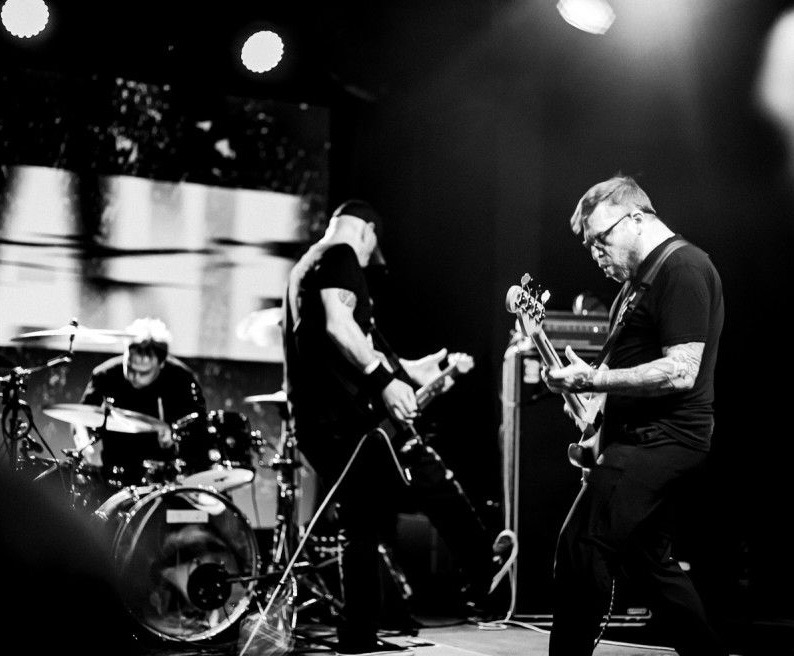
Photo provided by Chris Spencer
MK: As far as I know, you’re touring with Occupational Hazard because you’ve reclaimed the rights to your own music, and thanks to that, you’ve remastered the album the way you wanted. Did getting the rights back feel like an exceptional pleasure?
Chris: Oooh totally! We had only really let them have our music for three to five years, depending on the record. Then, the five years would be up, and I would try to get in touch with them, and they’d be, “Talk to our lawyer.” But the truth is they don’t want to pay their lawyer, so they just need to know that you’re ready to deal with their lawyer.
MK: Would you say, in hindsight, that some of the record deals you made were not the right thing to do?
Chris: No, basically, all of them were good. Basically. Initially, we were on Matador, and then Matador got bought out by Atlantic when the whole Nirvana thing hit. So, they were just trying all these noisy bands to see if they could get something to grow and bring them money. At the time, a major label would give you 11% of everything. Then, you would spend all this money on advertising and stuff, and they would say it was recoupable.
Once, we were on tour, and they handed some guys, who were gonna make a video, about $8,000. I was like, “Why are you handing our money out to people and not getting our approval?” I do video stuff, and I would rather do it myself. Also, one day, a friend of mine was playing some video game (Ed. note: Tony Hawk’s Pro Skater (1999)) and was like, “Hey, do you know you’re on this video game?” I didn’t know that, and that’s shifty when they’re licensing your music to a big video game and not letting you know.
I’ve always hated big labels, and I prefer smaller ones. Once Matador got bought up by Atlantic, I hit up my friend Tom Hazelmyer. He runs a label called Amphetamine Reptile Records that had a lot of good bands on it at the time, like Cows, Surgery, Hammerhead and others. Tom is a handshake-deal person, so he made it all really easy. He was also more generous and did not go throwing money around while also trying to promote our band. He was way more sensible.
Scattered, Smothered & Covered came out via Amphetamine Reptile Records in 1995.
With Relapse, we signed a three-record deal, which got us more exposure. That’s when Occupational Hazard came out. After that, Jello Biafra of Dead Kennedys, who’s a friend of mine, asked us if we’d like to do a record on Alternative Tentacles, and we agreed. So, I’ve done a string of small labels. And everybody’s honest. The only labels that made things difficult were Matador and Relapse, with Relapse eventually giving it all up and being cool about it. It just took a little while.
MK: I’ve heard a lot from newer bands that, once they are done recording and producing new material, they are pretty tired of hearing it. You, by contrast, fight with labels to improve or alter your music. The music you’ve been touring with forever…
Chris: Yeah, I get that, too (laughs). But, you know, when I do listen to an old record, I’m kind of like, “Oh, it could be a little more of this or that.” I totally hear it. Back in the day, when Occupational Hazard came out, technology was not quite as good as it is now, obviously. So, we wanted to push certain frequencies and help it out a little. It was just this very slight sound thing, like getting a higher output and a tiny bit more of high-mid frequencies. My friend Andrew Schneider has done a few of our records, and they’re just really powerful. We wanted to get the record more in that ballpark.
MK: Lyrics are another thing you’ve been carrying with you for quite a long time. In your perception, does the lyrical part of Occupational Hazard connect to things that are relevant now, in the moment, or do the lyrics stick more to their original symbolism?
Chris: I kind of think they do connect in a way. Well, there’s kind of both. It’s still sort of what was being said about how everything was fucked up then. This album is really about my neighborhood in New York. I would be on tour, and then I’d come home, back to where people would sell drugs on my street, other people would get mugged and all kinds of stuff. It was just really violent and crazy.
What I’ve always done when I write lyrics is remind myself of a certain time or situation without being completely obvious about it. So, when we play those songs, even though it’s been years and years, they take me back to that time.
MK: You’re working on a new record. Where are you with that now?
Chris: Yeah! Right before we came here, I wrote and recorded, just on my home recording stuff, nine new songs. So, I’ve got most of the record already done, with the lyrics all changing and moving around now. It’s not a huge departure. It’s different, but it’s still Unsane. I don’t want to lose what this band is. Also, from playing with these guys now, touring together, I feel like doing a little more high-energy on this record.
MK: These days, it feels almost obligatory for every new record to be about World War III paranoia and making poor choices as humanity. Will your one have this tone?
Chris: I don’t knooow (laughs), but I would say some of the stuff I’ve been talking about has been sort of foretelling, to a certain extent. New York is on the forefront of what’s coming for everyone else. What’s happening there will happen to all these cities. Now, with technology and stuff, things are going to change, too. I think so, but who knows?
According to the latest update from Chris, he was driving their equipment up for recording.